
The equipment
What you are actually lying on
Most salons show you a price list and leave it there. Here is what the beds are, what the numbers on them mean, and how they are looked after — because the difference between a good session and a poor one is mostly equipment and maintenance.
Lay-down
Full-length beds with facial tanners
The bed most people picture. You lie on a toughened acrylic canopy with lamps above and below, so the front and back of the body are covered in one session. Separate facial lamps sit at the head end and can be turned down or off entirely — the face is thinner-skinned than the body and many people prefer it that way.
The advantage is comfort. Twelve minutes lying still is an easier twelve minutes than standing, and for anyone who finds a booth close, this is the better room. What any given session achieves varies between individuals.

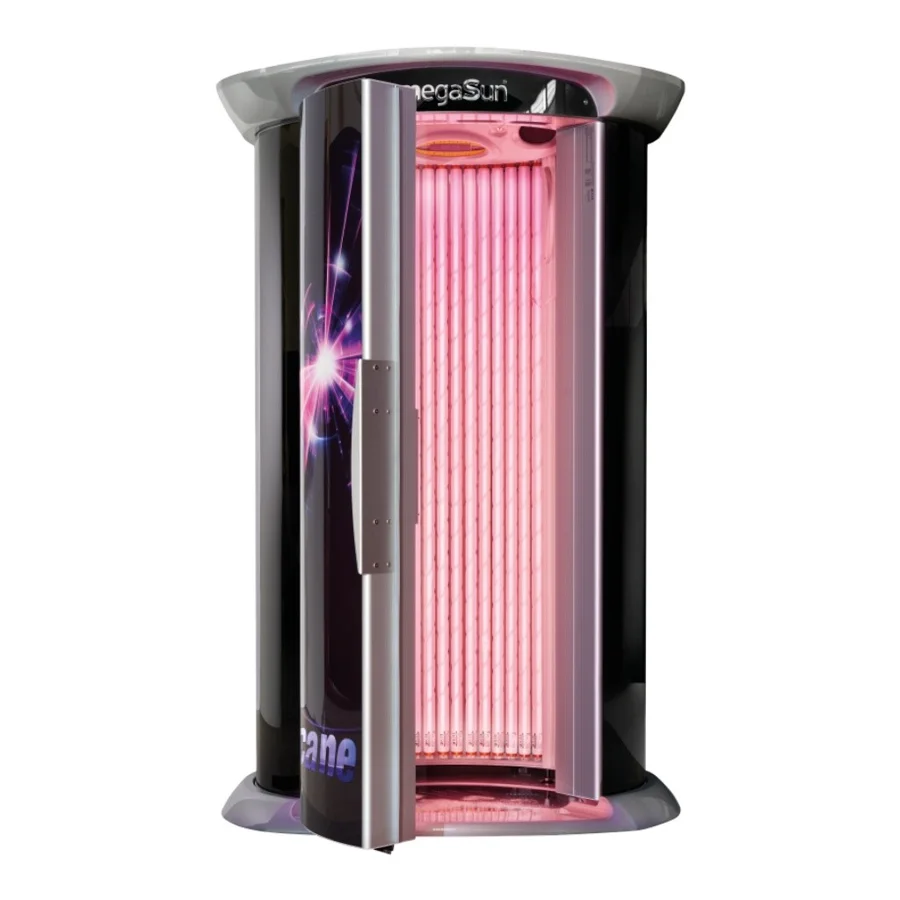
Photograph courtesy of megaSun.
Stand-up
Vertical booths, no surface contact
You stand in the middle with lamps all around you. Nothing touches the acrylic, which is why people who care about hygiene tend to choose them — though in practice every bed here is cleaned and sanitised between clients either way.
Booths are generally stronger than lay-downs, so sessions are shorter. They also tend to give the most even colour, because there are no pressure points where your body rests against the surface. Turning slowly through the session helps.
The number that matters: 0.3 W/m²
Every commercial sunbed in the UK is limited by standard to an effective erythemal irradiance of 0.3 watts per square metre. That is not a marketing figure and it is not something a salon chooses. It is the ceiling, and it applies to the strongest bed in the country exactly as it applies to ours.
What it means in practice is that a bed cannot simply be made stronger to sell shorter sessions. Output is held to a defined level, which is why session lengths across reputable salons land in roughly the same range. A salon quoting dramatically shorter times for the same result is telling you something about its marketing, not its equipment.
Low-pressure lamps, and why the old comparison fails
If your reference point is a sunbed from fifteen or twenty years ago, the equipment has genuinely moved on — and not in the direction people assume. Modern low-pressure lamps are built to a specified balance of UVA and UVB rather than simply being as strong as possible.
That balance matters because UVB is largely what burns and UVA is largely what develops colour in the skin you already have. A lamp weighted for a controlled amount of UVB is aiming for colour that comes on more gradually and is less likely to leave you burnt. It is a real improvement in control, and it is not a claim that a session is without risk — see the tanning guide, which sets out what the evidence actually says. How skin responds varies between individuals.
Lamps age, and a tired lamp is a wasted session
This is the part nobody advertises. A tanning lamp does not fail; it fades. Output falls gradually across its rated hours, so a bed running old lamps still lights up, still feels warm, and still charges you the same — while doing progressively less. You cannot see the difference and you cannot feel it. The only protection is a salon that tracks hours and changes lamps on schedule rather than when someone complains.
It is a fair question to ask any salon, including this one, and you should get a straight answer at reception.
Between every client
- Acrylics cleaned and sanitised with a product intended for tanning acrylics — household cleaners can craze the surface and shorten its life.
- Goggles provided free, every session. Closing your eyes is not protection: UV passes through the eyelid.
- Ventilation and cooling checked, because a bed that runs hot is uncomfortable long before it is anything else.
- Rooms reset so you are not clearing up after the person before you.
Not sure which is right for you?
Come in and look at both before you book anything. We will talk through skin type and a sensible starting length — there is no charge and no obligation.